• Skip to main content
  • Skip to primary sidebar
  • Skip to footer

Dark Energy Spectroscopic Instrument (DESI)

  • / science /
    • science overview
    • cosmology and dark energy
    • redshifts and distance
    • mapping the universe
    • the DESI science mission
    • the DESI survey
    • imaging surveys
  • / instrument /
    • instrument overview
    • telescope
      • tohono o’odham
    • corrector
    • focal plane system
    • fiber system
    • spectrograph
    • instrument control system
    • data systems
    • bringing DESI to life
      • commissioning Instrument
      • protoDESI
  • / collaboration /
    • DESI team
    • DESI builders
    • collaborating institutions
    • sponsors
    • code of conduct
    • vendors
    • collaboration policies
  • / press /
    • announcements
    • in the news
    • press releases
    • tweets by desisurvey
    • blog
    • acknowledgments
  • / galleries /
    • videos
    • image gallery
  • / for scientists /
    • data releases
    • instrument design
    • imaging data
    • target selection and survey validation
    • theory and simulations
    • other DESI science
    • key publications
    • all DESI papers
    • team login
    • request a DESI speaker
    • internal
  • / education & outreach /
    • meet a DESI member
    • blog
    • DESI High
    • planetarium show
    • interactive visualizations
    • DESI Merch

BaoBan Greets Spectators at 2025 Tohono O’odham Rodeo Parade

February 20, 2025 by joannajita

joannajita

Caption: BaoBan appeared high atop the KPNO float at the 2025 Tohono O’odham Nation Rodeo Parade. Credit: M. Edwards
Joan Najita (NOIRLab)

20 February 2025

BaoBan, DESI’s ambassador for Education and Public Outreach, recently dropped in on this year’s Tohono O’odham Nation Rodeo Parade, greeting parade spectators from high atop the Kitt Peak National Observatory (KPNO) parade float. The DESI project is being carried out at KPNO, which is located atop I’oligam Du’ag, in the homeland of the Tohono O’odham Nation. A coyote from the wilds of Arizona, BaoBan also took a star turn at last year’s Rodeo Parade.

At this year’s parade, held on 1 February 2025 in Sells, Arizona, BaoBan appeared on the KPNO parade float alongside images of Tohono O’odham employees and those who have supported the Observatory over the past 60 years. Decorated with colorful images of stars and planets, the float joined in on the parade theme “Celebrating Our O’odham Superheroes” with BaoBan sporting his own superhero cape. NOIRLab volunteers also walked alongside the float clad in vibrant capes and masks.

Caption: NOIRLab volunteers pose with their parade entry at the 2025 Tohono O’odham Nation Rodeo and Fair. The theme was “Celebrating Our O’odham Superheroes”. From left: Jessica Harris, Carolina Vargas, Sarah Logsdon, Alice Jacques, Lori Allen, Michelle Edwards, and Jacelle Ramon-Sauberan. Credit: T. Schleicher

Now in its 86th year, the Tohono O’odham Nation Rodeo and Fair is an important tradition that celebrates Tohono O’odham culture and history. In addition to the all-Indian rodeo, the event featured live music, fairground rides, exhibitions and food booths. At the NOIRLab information booth, volunteers, including DESI astronomers, invited fair attendees to view the Sun through telescopes and to visit Kitt Peak to learn more about projects such as DESI. A special thanks to BaoBan and all volunteers for their help making this event a “super” success!
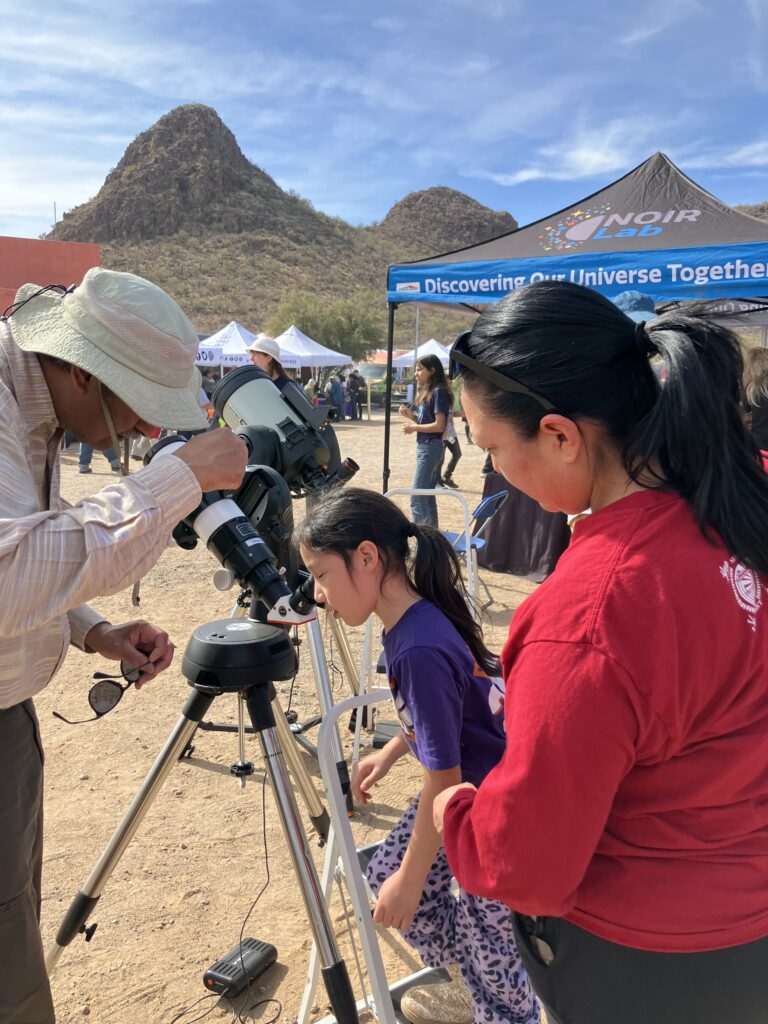
Caption: At the NOIRLab booth, DESI astronomer Arjun Dey helps a young visitor check out the Sun. Credit: J. Najita

Filed Under: blog, feature on homepage

Supermassive black holes are found at the centers of almost all massive galaxies. Credit: NSF/AUI/NSF NRAO/S.Dagnello

Joan Najita (NOIRLab)

8 February 2025

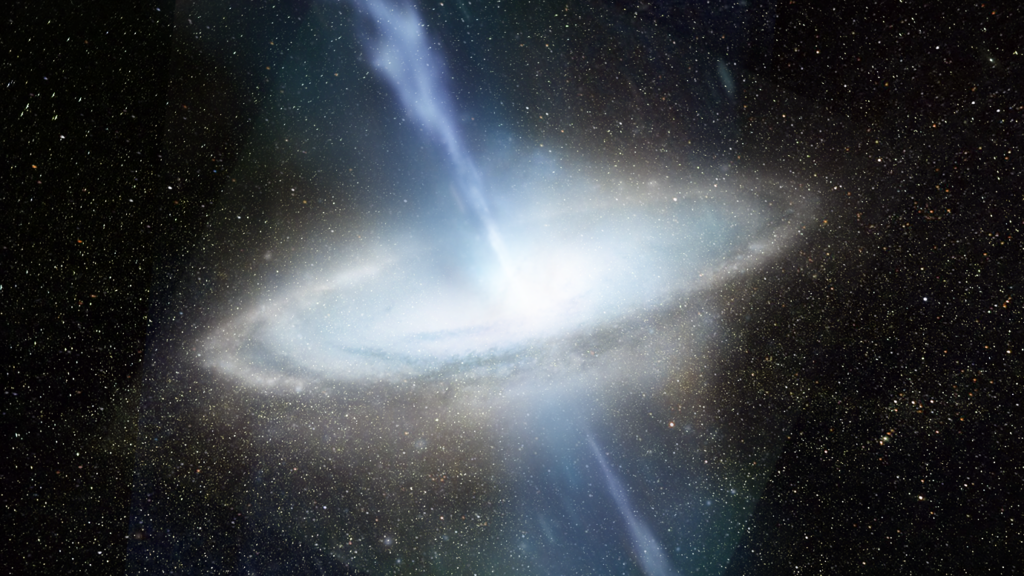
One of the remarkable things we’ve learned about galaxies over the past few decades is that they often come with a special surprise in the middle — a huge black hole. Weighing in at more than a million times the mass of the Sun, these “supermassive black holes” are found at the centers of almost all galaxies similar to or more massive than the Milky Way. Why do galaxies have these black holes? And how did they get there? Do much lower mass galaxies also have central black holes? These questions have motivated the search for black holes in low-mass “dwarf galaxies,” systems that may provide vital clues regarding the origin of black holes in the Universe.

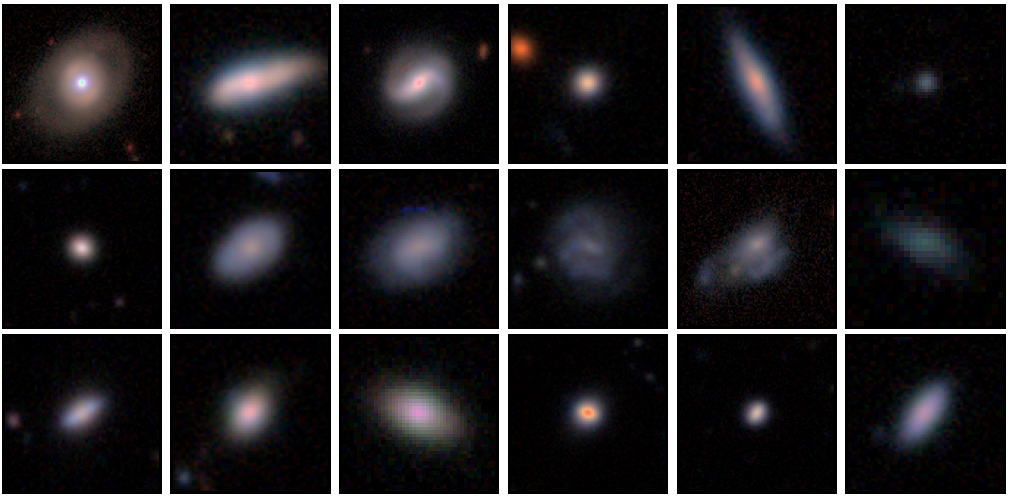
A recent paper, led by Ragadeepika Pucha (U. Utah), takes a big step in this direction. Analyzing DESI spectra of dwarf galaxies, the researchers identified candidate black holes that are actively accreting matter from their surroundings. The feeding process produces a characteristic spectrum of bright atomic emission lines that the researchers used to identify these systems as Active Galactic Nuclei (AGN). The study detected AGN signatures in over 2000 dwarf galaxies, more than tripling the number of known dwarf galaxies with candidate black holes. The detections, which extend to lower galaxy masses and higher redshifts (i.e., further back in time) than previously probed, suggest that black holes may commonly exist even in these very low-mass galaxies.

We sat down with Raga to learn more about this remarkable result.

A montage of dwarf AGN candidates studied in Pucha et al. (2025), created using the Legacy Survey Sky Viewer and images from the Subaru Telescope’s Hyper Suprime-Cam. Each image is 30 kpc on a side.

Questions for Raga:

Q: Why was it important to increase the census of dwarf AGN? Was this difficult before DESI?

A: Dwarf galaxies are the most abundant galaxies in the Universe, and understanding their growth is crucial for piecing together the puzzle of galaxy formation and evolution. Because their lower mass (and therefore lower gravity) makes it more challenging for them to hang on to their gas, the energy output from the AGN, which can eject gas from a galaxy, can potentially have a major impact on a dwarf galaxy’s ability to continue to form stars. What happens exactly remains an open question. To explore this complex interplay between dwarf galaxy evolution and black hole evolution, we first need to establish a robust statistical sample of dwarf AGN candidates.

Historically, this has been a real challenge. Because low-mass galaxies are faint, it has been difficult to measure the spectra of a large sample and identify dwarf AGN candidates. But DESI is changing the landscape with its ability to measure spectra of many objects simultaneously. The early DESI data included spectroscopy of nearly 115,000 dwarf galaxies, from which we uncovered the largest sample of dwarf AGN candidates to date. Part of the success is the result of the smaller fiber size of DESI, which makes it easier to  focus on the light from the central region of the galaxy, where the AGN is, and ignore the starlight from the rest galaxy. As a result, we were able to identify fainter dwarf AGN candidates than in previous studies.

Q: It looks like you find that dwarf galaxies also commonly host black holes. Do these results tell us anything about the origin of supermassive black holes in general?

A: A major question about supermassive black holes is how they formed. What mass did the black hole start out with? What was its “seed” mass? Because lower mass galaxies are likely to harbor lower mass black holes, they may provide a bridge between stellar mass black holes (< 100 solar masses) — which are familiar to us from X-ray binaries and LIGO gravitational wave sources — and supermassive black holes at the centers of large galaxies. These “intermediate mass black holes”, while elusive to date, are theorized to be the “seeds” of supermassive black holes and the relics of the first black holes formed in the Universe.

With DESI, we’ve found the lowest mass black holes in galaxies to date. Since black holes can only grow over time and cannot disintegrate into smaller ones, these findings suggest that the black holes we are observing may be analogs of the primordial black holes that formed in the early Universe, i.e., the “seed black holes” of supermassive black holes. A very small number of our sources may even be primordial black holes, having persisted through the ages with little to no evolution.

Q: What do you find most interesting about the results?

A: We find that nearly 2% of dwarf galaxies host active black holes, a significant increase compared to the ~0.5% reported in earlier studies. This is an exciting result, as it suggests that we have been missing a substantial number of undiscovered black holes. It opens the possibility that even more black holes are concealed within these low-mass galaxies.

The ability to detect an active black hole depends on several factors, including the black hole’s mass, the availability of gas in its vicinity, the accretion rate, and the sensitivity of the instruments used to detect the emission from the resulting AGN. As a result, for a given galaxy mass, the black holes we observe will tend to be either the most massive or those with the highest accretion rates, depending on the specific telescope and instrument used.

Our findings show that the fraction of galaxies hosting actively accreting black holes increases with galaxy mass, reaching nearly 100% for the most massive galaxies. This suggests that when a massive galaxy has an active black hole, it is readily detected by DESI. In contrast, in lower-mass galaxies, the emission from ongoing star formation can mask or dilute the AGN signal, making it harder to detect their faint AGN. This does not imply that low-mass, star-forming galaxies do not host black holes, but rather that we are currently identifying all the actively accreting black holes that are detectable with our instruments.

Q: What drew your interest to this topic?

A: When I began my PhD, my primary goal was to delve into the field of galaxy formation and evolution. I was particularly drawn to dwarf galaxies, as they are the most common kind of galaxy in the universe, yet they remain poorly understood. What are their histories? Do they follow the same evolutionary path as more massive galaxies? Or does the energy released by their active black holes (if they have one) play a significant role in shaping their growth?

By sheer coincidence, my advisors, Stephanie Juneau and Arjun Dey, encouraged me to join the DESI collaboration, which turned out to be the perfect opportunity to dive deeper into this research. They were incredibly supportive of the idea to use DESI data to search for dwarf AGN candidates as a first step in understanding the evolution of dwarf galaxies in the universe.

An unexpected bonus was realizing that this project also ties into one of the most fundamental and exciting questions in present day astronomy: the formation of supermassive black hole seeds. The chance to simultaneously explore the evolution of dwarf galaxies and the origins of supermassive black holes has been deeply motivating. The interconnection between these two lines of inquiry, and the potential to advance our understanding on both fronts, has been a truly rewarding aspect of my research journey.

Q: What’s next for you?

A: With the largest sample of dwarf AGN and IMBH candidates now at our disposal, we are poised to tackle some of the most pressing questions in the study of supermassive black hole seed formation and the co-evolution of dwarf galaxies and their central black holes. My upcoming projects will focus on examining the relative effects of AGN versus star-formation feedback in dwarf galaxies, exploring the energetics related to these feedback mechanisms, and characterizing the population of dwarf AGN candidates identified through multi-wavelength and multi-diagnostic approaches.

My DESI collaborators and I also plan to investigate the demographics of these black holes, employing modeling techniques to study whether all galaxies have black holes (or what fraction do), as well as the black hole mass function in the universe. We will expand these analyses to include DESI Year 3 data, which will further enhance the scale and scope of our research.

Filed Under: blog, feature on homepage

Joan Najita (NOIRLab)

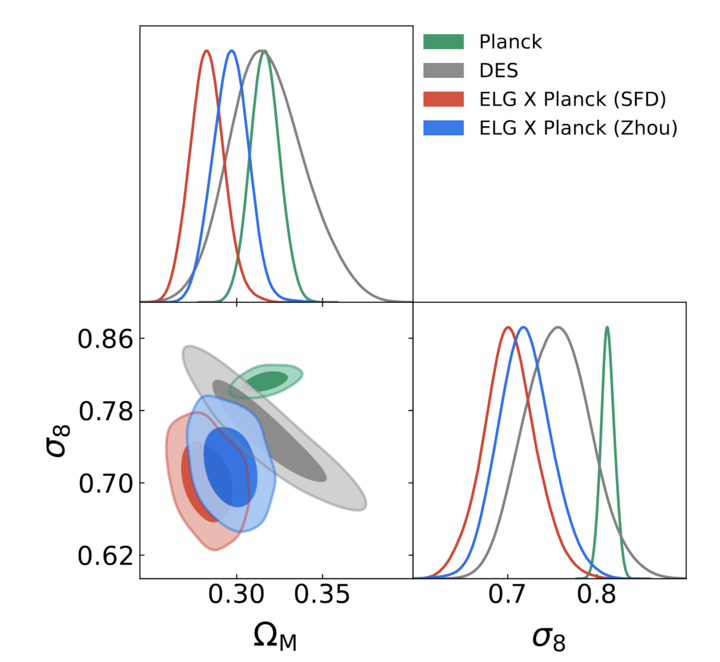
Cosmology parameters Sigma-8 and Omega-M inferred from the clustering of DESI emission line galaxies (ELG) using old (red) and new (blue) corrections for Milky Way dust, compared with parameters inferred from the CMB (green).

One of the current tantalizing mysteries of cosmology is the “Sigma-8 tension,” or the persistent disagreement between the predicted and observed amounts of “clumpiness” of matter in the Universe. Briefly, the small density fluctuations in the early Universe (as recorded in the cosmic microwave background or CMB) can be used to predict the expected matter density fluctuations at later times, up to the present day. While the observed clumpiness of the matter density distribution at later times agrees well with expectations from our current cosmological model, observations consistently find less clumpiness than predicted by the CMB. The difference may indicate exciting new physics, or more prosaically, systematic effects.

A new paper led by Tanveer Karim explores the Sigma-8 tension using data from the DESI Legacy Imaging Survey. Similar to previous studies, the new paper also finds significantly less clumpiness in the galaxy distribution than predicted by the CMB (i.e., the red and blue shapes are below the green shape in the lower left panel of the figure). However (and interestingly), the results also depend on how the effect of intervening dust in our own galaxy is taken into account. In other words, our view of the Universe from within a galaxy means that dust in the Milky Way can block light from fainter distant galaxies, altering the apparent clumpiness of the galaxy distribution. Much like explorers of old, astronomers need to “brush away” this surface dust to reveal the cosmological relics of interest beneath. Here the authors make this correction using a new map of Milky Way dust, derived from DESI data itself. The correction reduces the tension (blue shape), but the clumpiness of the galaxy distribution still differs from the CMB prediction (by 3-sigma).  We sat down with Tanveer to learn more about the results.

Questions for Tanveer:

Q: How do you interpret these results? Is your measurement of Sigma-8 significantly different from the CMB value? And should we be concerned? (Or maybe excited about the prospect of new physics?)

A: As a bit of background, our results add to the “sigma-8 tension” story in two ways. Firstly, we find that the tension is already present quite a long time ago, at a redshift of z ~ 1.1, when the Universe was not yet affected by dark energy (in LCDM cosmology). Secondly, our study examines the clustering of lower-mass blue galaxies rather than massive red ones. That is, we study emission-line galaxies (ELGs), which are similar to the mass of the Milky Way. Previous studies have used luminous red galaxies (LRG) (Sailer 2407.04607, Kim 2407.04606, White 2111.09898, Kitanidis 2010.04698) or unWISE galaxies (Farren 2309.05659, Krolewski 2105.0342) that are typically 100-1000 times more massive than ELGs.

So, what do our results mean? The more exciting interpretation is that we are perhaps seeing hints of something new (not the traditional constant dark energy) happening at z ~ 1.1. But if we consider the LRG and unWISE galaxies as well, then our result is the outlier. What could explain this? The key could be that the previous studies studied massive red galaxies while we are probing the clustering of lower-mass blue galaxies, like our Milky Way. Why does this matter? While the CMB traces the clustering of dark matter, galaxy clustering studies are observing normal matter. To compare these, we need to understand how galaxies form in dark matter clumps and how well different galaxy populations trace the dark matter. So naturally, galaxy formation and other processes can come into play. Our understanding of Milky-Way-mass galaxies is limited at such high redshift, so perhaps our results not only point to the impact of systematics but also signatures of unknown ELG galaxy physics!

Q: How do your results relate to other studies of clumpiness? The Sigma-8 tension is also reported by studies that use completely different measures of the clumpiness of the Universe (e.g., weak lensing, galaxy cluster counting). Does the Milky Way dust distribution also affect these studies? Or are these other studies affected by different systematic effects?

A: That’s an interesting question that has not been explored at length yet, although there may be a possible connection. Papers such as (https://arxiv.org/pdf/1808.03294) and (https://arxiv.org/abs/2306.03926) have shown that certain extinction maps actually retain imprints of the large-scale structure of galaxies, because they use far-infrared light to map dust. While most of the far-infrared light is produced by dust in the Milky Way, distant star-forming galaxies also contribute. If their emission is incorrectly attributed to Milky Way dust, the process of correcting for Milky Way dust will incorrectly imprint a signature of distant star-forming galaxies on images of the sky, which may affect these other measures to some extent.

In any case, and as far as I am aware, our paper is the first to show exactly how much these effects change the effect of Milky Way dust changes our cosmological interpretations. As for the other galaxy clustering measurements, I think one could argue that since the earlier studies were using more massive galaxies, they were less prone to extinction systematics. But a reanalysis of such works will be important to definitively rule out the role of Milk Way dust. After all, Milky Way dust has impacted cosmological results in the past, such as the false detection of the primordial B mode in the CMB by the BICEP telescope!

Q: Does dynamic dark energy play a role here? As you say in your paper, the negative pressure of dark energy inhibits the growth of large-scale structures over time, countering the effect of gravity. Earlier in 2024 DESI reported that dark energy may be dynamic and weakening. Does this effect matter in your study? If it does, do you take this development into account?

A: I am puzzled by the recent DESI Key Paper results—in a very positive way—as I am sure many of the DESI collaborators are! While I do not have a clear answer on how dynamic dark energy relates to a detection of Sigma-8 disagreement at z ~ 1.1, it is a line of questioning we should consider seriously in interpreting the upcoming Y3 dataset (next major dataset for DESI). The Y3 dataset will be much cleaner than the Y1 data in our current paper, and I expect it will show a more robust detection of the ELG-CMB lensing cross-correlation. We should consider the impact of dynamic dark energy in this context, where the simplest extension of our current study would be to measure not only Sigma-8 and Omega_matter but also the parameters describing the dark energy equations of state (w0, and wa).

Speaking of these earlier reports, it’s interesting that an echo of our current results is also found there. While the November 2024 Full-Shape and Redshift Space Distortion (RSD) results measure Sigma-8 with many tracers and find it to be consistent with the CMB, if you look at Figure 1 of the full-shape paper (https://arxiv.org/pdf/2411.12022), you will see that the ELGs on their own are also consistent with a lower Sigma-8! The two studies are done in different ways — the full shape result derives from the 3D clustering of ELGs, while our analysis is carried out in 2D using ELGs selected in a different way — it is interesting that our two independent methods yield similarly low Sigma-8s. This naturally links back to the first question and leads me to wonder, if not a signature of dark energy, could we be on the verge of understanding how these early star-forming galaxies were interacting with their dark matter haloes?

Q: How did you decide to work on this project? Were you surprised by the results?

A: After I finished my initial work on the ELG target selection as a first and second-year graduate student, I was interested in exploring how to use the DESI ELG sample to study cosmology. Extensive discussions with my thesis advisor, Daniel Eisenstein, and collaborators of this project, Sukhdeep Singh and Mehdi Rezaie, helped me understand that the high-redshift star-forming galaxies could be the key to unlocking the early large-scale structures. I never thought that I would have to learn so much about “local” structures, such as the Milky Way dust mapmaking and the Sagittarius Stream, to learn about the very distant cosmos, so it was both shocking and exciting to see how the science of the distant Universe and that of our local neighborhood is becoming more and more intertwined.

Q: What’s next for you?

A: As an Arts & Sciences Postdoctoral Fellow at the University of Toronto, I am currently finishing up a similar analysis using the same ELGs, but this time cross-correlating with the cosmic infrared background, to quantify the star-formation rate of these galaxies and their galaxy-dark matter halo connection. I am excited to see what more we can learn about the ELGs and whether a better understanding of their physics can help us better interpret the CMB lensing cross-correlation results. My ELG work also made me fall in love with these early star-forming galaxies, and so I am currently co-leading the Lyman-Break Galaxies (LBGs) Topical Team in the Dark Energy Science Collaboration (DESC). The hope is that with the upcoming Rubin Observatory, we will explore all the up to z ~ 5.5 using LBGs. The coming years of wide-field high-redshift surveys will be the era of ELGs and LBGs, and I am thrilled to see what these galaxies will teach us about the infancy of our Universe.

Filed Under: blog, feature on homepage

Joan Najita (NOIRLab)

DESI reaches 50M milestone

On 18 December 2024, DESI reached a new milestone, having measured the spectra of 50 million astronomical sources (36.3 million galaxies and quasars, and 13.7 million stars) over 819 nights of observations. The milestone is remarkable for both its speed and scope. As described by DESI team member Arjun Dey (NOIRLab), “When we originally proposed the DESI project, we forecast that we would measure spectra of about 38 million sources (30 million galaxies and quasars and 8 million stars) over the 5-year survey. We have now already exceeded that mark in just 68% of our official survey time.”  While the 50M milestone has been reached quicker than expected, many of the spectra were obtained in “bright time”, when the moon is up. The main “dark time” portion of the DESI survey is still underway. Currently ahead of schedule, it is expected to complete toward the end of 2025.

DESI headlines Quanta Magazine’s list of 2024’s Biggest Breakthroughs in Physics

In other news, DESI’s announcement earlier this year — that dark energy may be weakening — has been highlighted by Quanta Magazine in an article and video as one of the biggest Physics stories of 2024. The finding offers a tantalizing hint about one of the biggest mysteries in physics. Reported in April 2024, the results were obtained from the first year (Y1) of DESI data, which built the largest 3D map of the Universe achieved to date. More complete results, from the first 3 years of DESI data, are expected in 2025. Will they confirm the tantalizing hint that dark energy is dynamic and evolving? Stay tuned!

Filed Under: blog, feature on homepage

Lawrence Berkeley National Laboratory, 19 November 2024

Filed Under: press releases

Joan Najita (NOIRLab)

A graduate student at the Harvard-Smithsonian Center for Astrophysics, Claire Lamman studies the orientations and alignments of galaxies and what they can tell us about cosmology and the cosmic web. She is also a talented artist and the recipient of a National Academies of Sciences Excellence in Science Communication Award for work that includes the DESI “5000 Eyes” planetarium film and “doodle summaries” that translate the complexity of scientific papers for the public. We sat down with Claire to learn more about her recent astrophysics research on what tiny groups of galaxies can tell us about the Universe.
Q: Can you tell us about your recent paper?

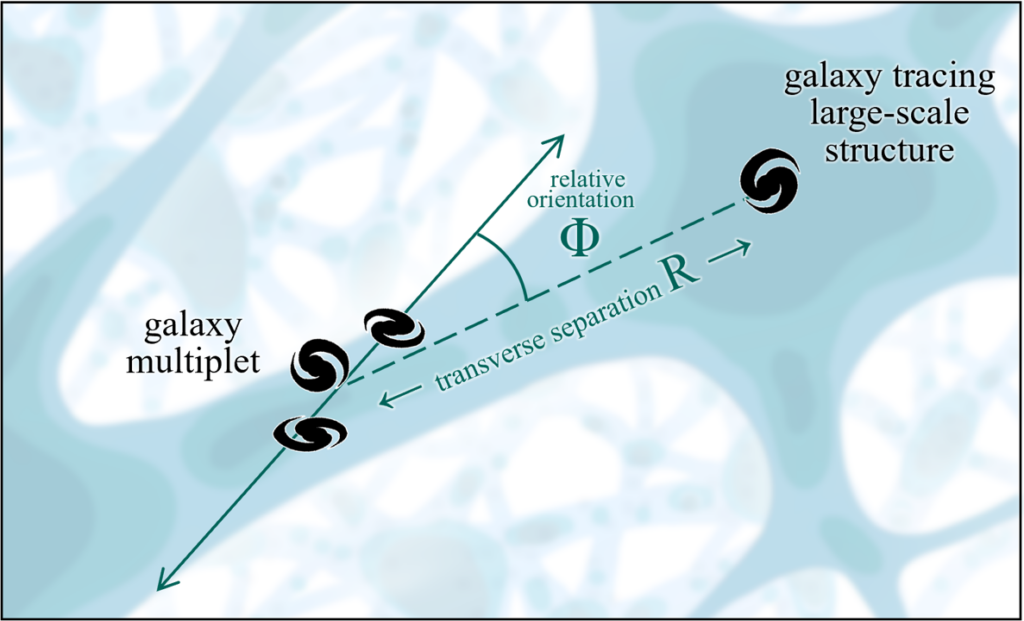
A: I was curious to see how the orientations of tiny groups (or “multiplets”) of galaxies correlate with the largest structures in the Universe (a.k.a. the cosmic web). It turns out that the orientations of multiplets tend to point towards other galaxies, implying that their positions are aligned with the cosmic web (please see graphic below). All multiplets remember the same large-scale structure, regardless of the type of galaxies in them. This is cool because usually stuff on small scales seems to forget the cosmic web it originated from. This effect may offer a new way to map out the large-scale structures of the Universe.

Q: You mentioned that stuff on small scales usually forgets about the cosmic web. Why doesn’t that happen here?

A: While galaxy orientations tend to “forget” their history in a very general sense, here we show that some memory is in fact preserved! This is likely a result of how the galaxies formed. My mental picture is matter (gas, dust, galaxies) being channeled along cosmic filaments and their angular momentum in that direction is preserved in the motions (and therefore positions) of the galaxies relative to each other and to the densest nearby regions, the large clusters / nodes where filaments meet.

Q: Can we make a map of dark matter using your technique?

A: Yes! Or, more specifically, a map of the tidal forces created by dark matter. This is similar to how weak lensing makes a “map” of dark matter between us and distant galaxies.

Q: What drew your attention to this topic? And why multiplets in particular?

A: Initially I studied the orientations of galaxies as a source of error in cosmological surveys. (For example, we expect the intrinsic alignments of galaxies to bias measurements of redshift-space distortions for DESI.) But eventually I became interested in their underlying cause. It’s  fascinating that things on relatively “small” scales (galaxies) can be connected to the largest structures in the universe!

Q: How does DESI help with this problem?

A: Because DESI measures the distances to galaxies, it helps us better determine which galaxies are close to each other along the line of sight. That helps us better identify multiplets and gives us better 3D information about their positions. These improvements help us find subtle correlations between galaxies and the cosmic web.

Q: What was your reaction to the results? Were you surprised?

A: Although I expected we would find some correlation, I was surprised at how clear the signal was! And I was also pleasantly surprised to find that we could detect a correlation in the most “difficult” sample: the faint, blue, distant galaxies. This is exciting because we do not see any evidence of alignment of these galaxies as individuals.

Q: What’s next on your horizon?

A: Getting my PhD! I’m excited to graduate and start postdoctoral research, where I hope to collaborate with theorists and experts in galaxy dynamics in order to better understand the modeling and applications of multiplet alignment.

More information about Claire’s recent work is available in this doodle summary of the actual paper and in this Halloween lunch talk (Claire’s presentation begins at 35:15).

Filed Under: blog, feature on homepage

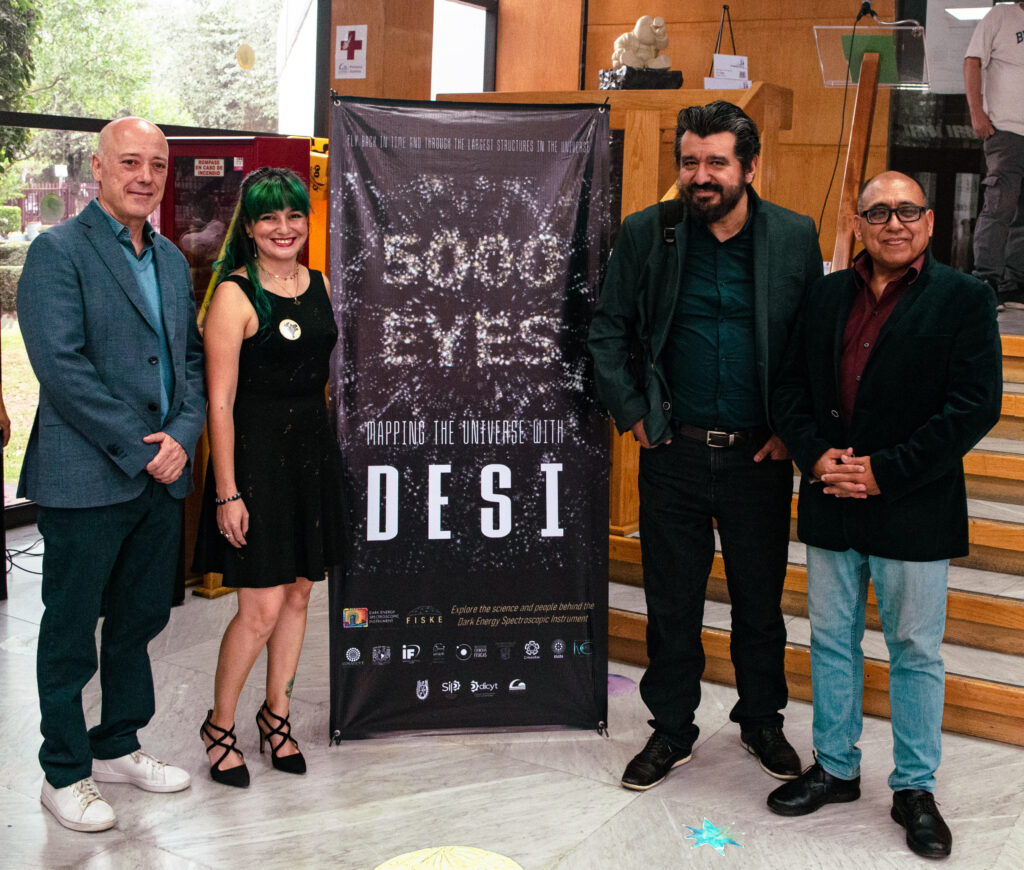
At the premiere of “5000 Eyes” in Mexico City: (left to right) Axel de la Macorra, Andrea Muñoz-Gutiérrez, and Octavio Valenzuela (DESI scientists), and Wilder Chicana (IPN). (Credit: Aldebarán López @aldebaran.smith)

by Andrea Muñoz Gutiérrez

On 20 June 2024, the DESI planetarium show “5000 Eyes” premiered in Mexico City at the Luis Enrique Erro Planetarium. Previously shown in traveling planetariums across the country, it is now, for the first time, part of the regular programming at the oldest planetarium in the nation. Authorities from several DESI institutions attended the premiere, along with numerous DESI scientists, both senior and early-career.

Dr. Axel de la Macorra and I spoke at the event on behalf of the DESI survey. Also present on stage to introduce the film were Dr. Abdel Pérez Lorenzana, Academic Secretary of Cinvestav (a DESI institution), and Dr. Tonatiuh Matos (DESI scientist), along with Dr. Ana Lilia Coria Páez and Dr. Omar Matamoros representing the Luis Enrique Erro Planetarium. Approximately 260 people enjoyed this inaugural screening of “5000 Eyes.”

Our goal for the event was to convey the wonder of the DESI project to both the authorities and the general public, and we had a significant impact. With the event covered by science communicators and the media, we conducted interviews and spoke with representatives from magazines, social media platforms, and newspapers, and even appeared on TV!

Attendees were wowed by the scale of the DESI project and very happy and thrilled by its results.

During the event, I was incredibly happy to share with colleagues, authorities, and the general public what we do in the collaboration and how we do it. When people approached us with questions, you could see the amazement and joy in their eyes, which is one of the greatest rewards a science communicator can experience.

Now, “5000 Eyes” will be part of the regular film schedule at this planetarium and will be shown at least three times a week. But there’s much more to come! Two planetariums in Guadalajara are set to host premieres in the next few months, and many other planetariums across the country are already interested in screening “5000 Eyes” to share with the public how DESI scientists are creating the largest 3D map in human history.

Several speakers introduced the DESI project and the “5000 Eyes” film at the premiere: (left to right) Omar Matamoros (representing the Luis Enrique Erro Planetarium), Axel de la Macorra (DESI scientist), Ana Lilia Coria Páez (representing the Luis Enrique Erro Planetarium), Abdel Pérez Lorenzana (Academic Secretary of Cinvestav, a DESI institution), Andrea Muñoz-Gutiérrez (DESI scientist), and Tonatiuh Matos (DESI scientist). (Credit: Aldebarán López @aldebaran.smith)

Filed Under: blog, feature on homepage

Some of the 600 visitors who visited Kitt Peak National Observatory for the Tohono O’odham Nation Open Night on 25 May 2024. Credit: KPNO/NOIRLab/NSF/AURA/A. Kocz

Joan Najita (NOIRLab)

30 May 2024

This past weekend, Kitt Peak National Observatory (KPNO) hosted an Open Night for members of the Tohono O’odham Nation. KPNO, where the DESI project is underway, is located atop I’oligam Du’ag (Manzanita Shrub Mountain) in the Tohono O’odham homeland. KPNO Open Nights celebrate the relationship between the Nation and the Kitt Peak astronomy community and express the community’s appreciation for the privilege of carrying out research at a site that is of deep historical and cultural significance to the Nation.

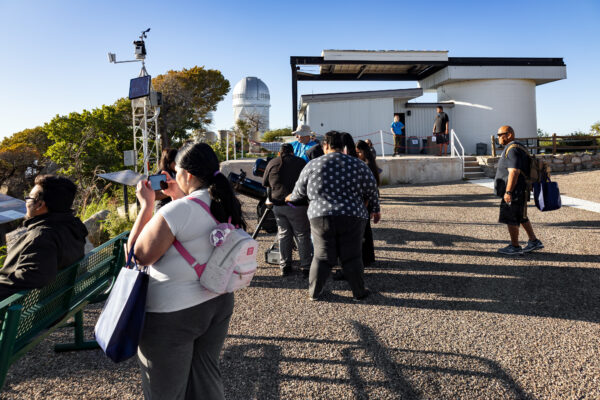
For the 25 May 2024 event, KPNO opened its doors, welcoming 600 Tohono O’odham community members to the observatory. Tribal members of all ages joined in a wide variety of activities, including solar and night-time telescope viewing, Waila music, hands-on activities, and observatory tours.

Visitors to the 4m Mayall Telescope were greeted by volunteers — including DESI collaboration members Dick Joyce, Luke Tyas, Chris Brownewell, Bob Stupak, Yuanyuan Zhang, and Joan Najita — who described the DESI project, its amazing technology and goals, and how the observations are carried out. Elsewhere on the mountain, DESI collaboration member and Mid-Scale Observatories Director Lori Allen greeted visitors as they arrived and helped them view highlights of the night sky through a small telescope.

Visitors observing the Sun through telescopes at the Sunset Point during the Tohono O’odham Nation Open Night on 25 May 2024. DESI’s home, the 4m Mayall Telescope, is in the background. Credit: KPNO/NOIRLab/NSF/AURA/R. Sparks

BaoBan, DESI’s ambassador for Education and Public Outreach, made several guest appearances. A coyote from the wilds of Arizona, BaoBan appeared on DESI-themed souvenir postcards created for the event and in the inaugural KPNO Newsletter for the Tohono O’odham Nation, both of which were distributed to visitors. BaoBan has previously appeared at the Tohono O’odham Rodeo, in comic strips, and other DESI-related public engagement activities.

The 25 May Open Night was long anticipated, with the recent coronavirus pandemic and Contreras fire of 2022 having disrupted the usual 2-3 year cadence of these events. With the mountain now reopened and normal observatory operations resumed, the Kitt Peak astronomy community was eager to restart the series. More than 70 volunteers from NOIRLab and Kitt Peak facilities worked together with local Tucson community organizations in hosting the event.

For Bob Stupak, NOIRLab Electronics Technician and DESI collaboration member, welcoming visitors at the Mayall was “a great time,” an opportunity to share the excitement of DESI with the community, resulting in smiles all around. He noted, “I was working at the top of the visitor’s elevator and everyone leaving the building seemed to have been really impressed.”

Further details about the event are available in a NOIRLab press release.

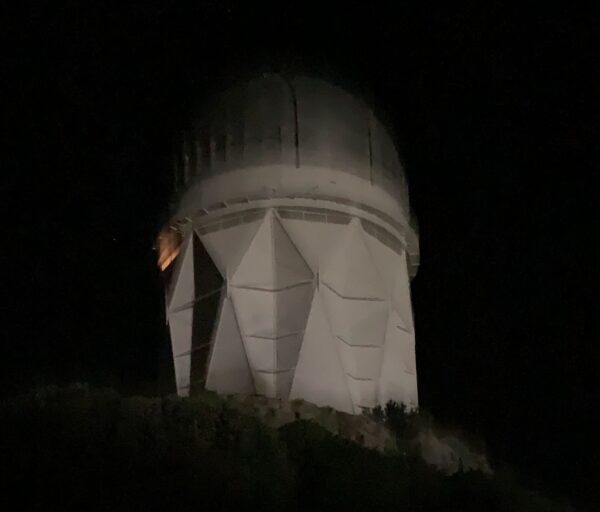
Rare night-time view of the 4m Mayall Telescope, illuminated by lights from the Tohono O’odham Nation Open Night. Credit: Bob Stupak

Filed Under: blog, feature on homepage

Joan Najita (NOIRLab) and Luke Tyas (LBL)

Science communicators across the internet are discussing DESI’s Year 1 results and their implications for the fate of the Universe. Here are some of the highlights.

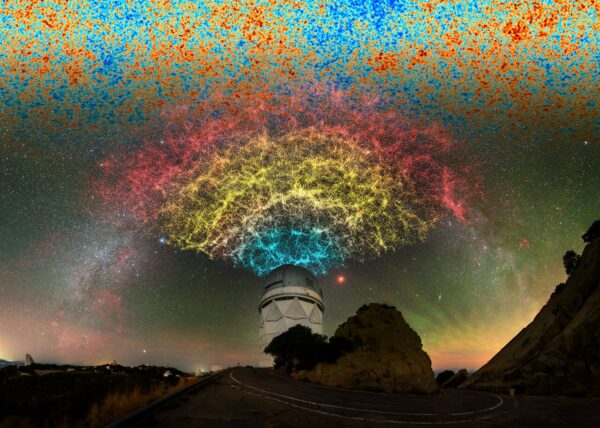
An artistic celebration of the Dark Energy Spectroscopic Instrument (DESI) Year 1 data, showing a slice of the larger 3D map that DESI is constructing during its five-year survey. DESI is mounted on the Nicholas U. Mayall 4-meter Telescope at Kitt Peak National Observatory. Credit:
DESI Collaboration/KPNO/NOIRLab/NSF/AURA/P. Horálek/R. Proctor

World Science Festival: Is Dark Energy Decaying? 

Brian Greene sits down with Michael Levi (LBL) to discuss DESI’s revolutionary observations that may upend our understanding of the cosmos. In an hour-long conversation that takes us from the discovery of dark energy to the birth of the DESI project and on to its Year 1 Key Project results, Greene and Levi highlight the cutting-edge nature of the story. That is, we’re finding an intriguing hint that dark energy is weakening (i.e., becoming “less pushy” over time), and but we’re not completely sure. Commenting on the uncertainty, and how we’ll know more soon, “This is why I love doing physics,” says Levi, “It’s detective novel that you get to read and discover, and it was written by the Universe!” As for the bigger picture meaning of the results, should they hold up, the weakening accelerated expansion of the universe seems reminiscent of the end of the inflationary expansion phase that marked the birth of the Universe. Levi finds it “appealing that we may be living in an epoch that ties back to the beginning of time.”

PBS Nova: New Map of the Universe Hints that Dark Energy May Be Evolving

This 3-minute video, which includes commentary from David Kaiser (MIT) and Priya Natarajan (Yale), describes how the DESI results could “fundamentally change what we know about the Universe and how it may come to an end.” Kaiser says the new DESI map of the Universe is more than a simple accounting where stuff is at any given moment. It also captures the Universe’s dynamics, creating something more like a movie that shows how fast space was stretching at different times over the Universe’s history. Natarajan emphasizes the possible cosmological implications of the results, noting that “If dark energy was a constant, the fate of the Universe would be grim.” Instead The DESI results appear to “open the door to the possibility of changing dark energy models”, which for Natarajan, “means that we have more exciting (possible) fates that await us.”

NPR: This week in science: Pompeiian frescoes, dark energy and the largest marine reptile  — NPR’s Mary Louise Kelly talks with Emily Kwong and Rachel Carson of Short Wave about how dark energy may be changing, with commentary from Priya Natarajan (Yale).

Dr Becky: Does the expansion rate of the Universe CHANGE over time?! DESI 1 year results — In this 12-minute video, astrophysicist Dr Becky Smethurst (Oxford) explains Baryon Acoustic Oscillations in words normal people can understand and walks the listener through the main plots and results from the Year 1 Key Project papers and press release.

Anton Petrov: Strange Expansion of the Universe Results from the Most Accurate Map — With a phenomenal 268,000 views as of this writing, this 12-minute video from scientist and educator Anton Petrov describes the use of Baryonic Acoustic Oscillations as a cosmological standard ruler and the implications of the DESI results for our understanding of what the universe “was doing billions of years ago, what it’s going to be doing in the future, and how all of this ends.”

AM24:First Year Results from the Dark Energy Spectroscopic Instrument (DESI) — Three talks by DESI scientists at the April 2024 meeting of the American Physical Society unveil DESI’s cutting-edge results. First, Hee-Jong Seo (Ohio University) presents the BAO results from galaxies and quasars at z < 2. Next, Julien Guy (Berkeley Lab) presents BAO results from the Lyman-alpha forest at z > 2. Finally, Mustapha Ishak (UT Dallas) presents the cosmology implications of the measurements.

Filed Under: blog, feature on homepage

Joan Najita (NOIRLab)

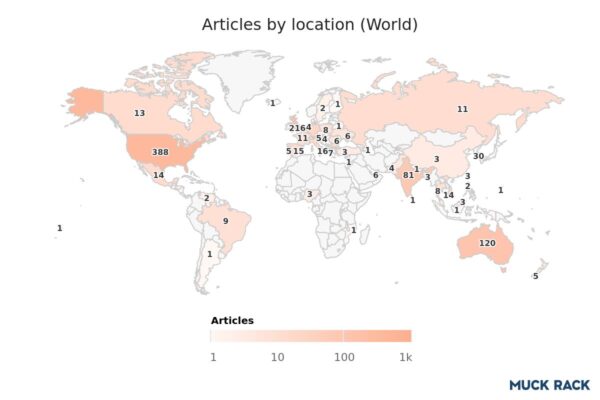
Articles in the media covering the 4 April 2024 press release, by location, as of 22 April 2024.

As described in a recent press release, DESI has found subtle hints that dark energy, once assumed to be constant in time, may instead be evolving. Spectra that probe the past 11 billion years of cosmic history suggest that dark energy appears to be weakening, becoming “less pushy” over time. That appears to be the message from the first year of DESI data when interpreted in combination with other data, i.e.,  supernovae and the cosmic microwave background. The news was covered in more than 1200 articles written in over 30 languages across the globe.

While DESI scientists caution that it’s too early to be certain, astronomers and physicists are excited by the news and the possibilities ahead. “If it holds up, this is a very big deal,” said Adam Riess, one of the discoverers of dark energy, speaking to New Scientist: “It may be the first real clue we have gotten about the nature of dark energy in 25 years.” Michael Turner, who coined the term “dark energy,” told the New York Times, “the possible evidence that dark energy is not constant is the best news I have heard since cosmic acceleration was firmly established 20-plus years ago.”

The original discovery, in 1998, that the expansion of the Universe is accelerating rather than slowing with time, could be understood as evidence that the vacuum of space possesses a tiny amount of energy of its own, i.e., a “dark energy.” That idea found an echo in an earlier proposal from Einstein of a “cosmological constant,” a concept that has been at the heart of our standard model of the Universe for the past two decades.

The model has been popular. In finding explanations for how the world and the Universe works, physicists sometimes use aesthetics as a guide and are drawn to explanations that have a simplicity or elegance, often of a mathematical kind. The standard model fits the bill. Explaining the attractiveness of the standard model and the role of the cosmological constant, Licia Verde told Quanta magazine: “It’s simple. It’s one number. It has some story you can attach to it. That’s why it’s believed to be constant.”

The new DESI results shake that foundation.

If dark energy isn’t a strict constant, who knows how it evolves. That uncertainty, and the potential unshackling from a cosmological constant, opens a richer set of potential futures for us. If dark energy continues to significantly weaken with time, it may become not only “less pushy,” but perhaps even “sucky,” causing the Universe to contract rather than expand. On the other hand, it may also grow stronger with time or possibly just fade away.

Commenting on these options, Durham University Professor Carlos Frenk told the Guardian that if DESI’s hints are right, our earlier understanding “goes out the window and essentially we have to start from scratch, and that means revising our understanding of basic physics, our understanding of the big bang itself, and our understanding of the long-range forecast for the Universe.”

The news may be soothing to some of us, at a human level.

In covering the DESI results, NPR characterized our current model of the Universe as painting a bleak picture of the future, i.e., that if dark energy is constant, it “will continue to push everything in the Universe apart. So much so that one day other galaxies won’t be visible from Earth. Even the stars in our own galaxy will die out, leaving behind a cold dark nothing…” Pretty depressing. But Priya Natarajan told NPR that the possibility of a changing dark energy opens the way to a happier ending: “Our fate may not be as lonely and desolate and grim as we imagine.”

Our understanding of exactly what the future holds depends on what we learn about whether and how dark energy is evolving. We should know more soon. The reported results are based on just the first year of data from the DESI survey, which is designed to extend over 5 years. So stay tuned!

Read other news reports on the recent DESI results here.

Filed Under: blog, feature on homepage

The Guardian, 4 April 2024

Filed Under: in the news

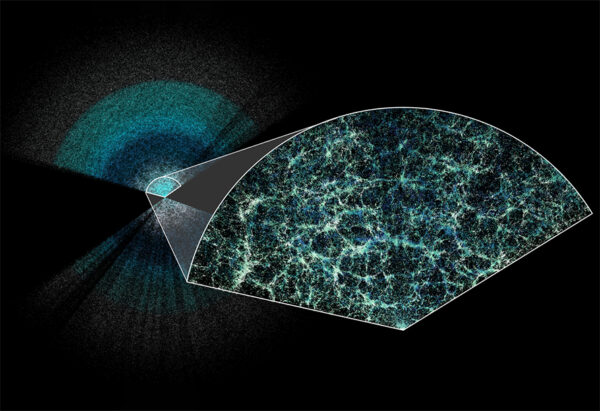
DESI’s map of the Universe is the largest to date. The delicate bubble-like structures in the distribution of galaxies—seen in the inset—record vital clues to the expansion history of the universe. Credit: Claire Lamman/DESI collaboration; custom colormap package by cmastro.

In its quest to study the effect of dark energy on the expansion history of the Universe, DESI has been charting the cosmos, creating the largest 3D map of the Universe ever made — a map that stretches back over 11 billion years of cosmic time.

In a press announcement today, the project made its initial report on the cosmological clues recorded in the map. The results make use of data from the first year of the DESI survey, which will be carried out over a total of five years.

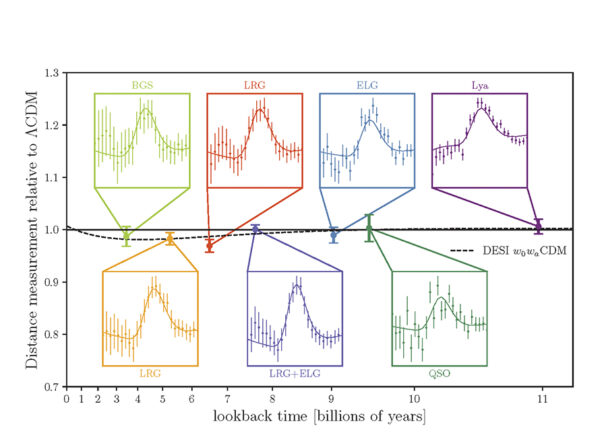
DESI’s 3D map tracks the frozen-in imprint of baryon acoustic oscillations (BAO), as recorded two ways: in the spatial distributions of galaxies, and in the structure of intergalactic gas seen along the line of sight to distant quasars (the Lyman alpha forest). Using these data, DESI scientists have measured the BAO signal at 7 epochs (i.e., slices of cosmic time) from 3 billion to 11 billion years ago. Because the measured BAO signal is a so-called “standard ruler”, the scientists can infer how the Universe expanded over its history.

The results are amazingly precise. Because of DESI’s high efficiency and stability, combined with its ability to measure spectra for large numbers of galaxies and quasars, the Universe’s expansion history is now known to better than 1% precision, yielding the best picture yet of how the universe has evolved.

The results are in general agreement with the current best cosmological model (Lambda CDM), which takes into account the roles of dark energy and dark matter. But as noted by DESI Director Michael Levi, “we’re also seeing some potentially interesting differences that could indicate that dark energy is evolving over time. Those may or may not go away with more data, so we’re excited to start analyzing our three-year dataset soon.”

With 4 more years of DESI data to come, stay tuned to see how the story evolves as DESI’s map reaches completion!

DESI’s measurement of the BAO signal at 7 cosmic epochs (from 3 billion to 11 billion years ago) are in general agreement with our current best model (Lambda CDM). Credit: Arnaud de Mattia/DESI collaboration.

These results were reported in multiple papers posted on arXiv and in talks presented today at the American Physical Society meeting. A guide to the suite of papers presenting these results is available at the DESI blog.

Filed Under: announcements

Joan Najita (NOIRLab)

12 February 2024 was a spectacular night for DESI: it broke its own record and acquired nearly 200,000 redshifts in a single night. The figure is remarkable, especially in the context of history.

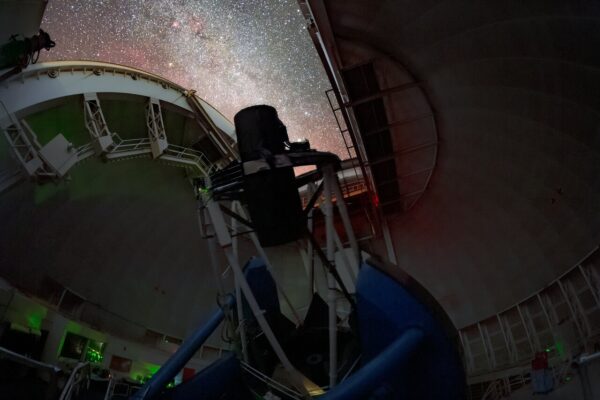
The Dark Energy Spectroscopic Instrument (DESI) observing the night sky on the Nicholas U. Mayall 4-meter Telescope at Kitt Peak National Observatory in Arizona. Credit: KPNO/NOIRLab/NSF/AURA/T. Slovinský

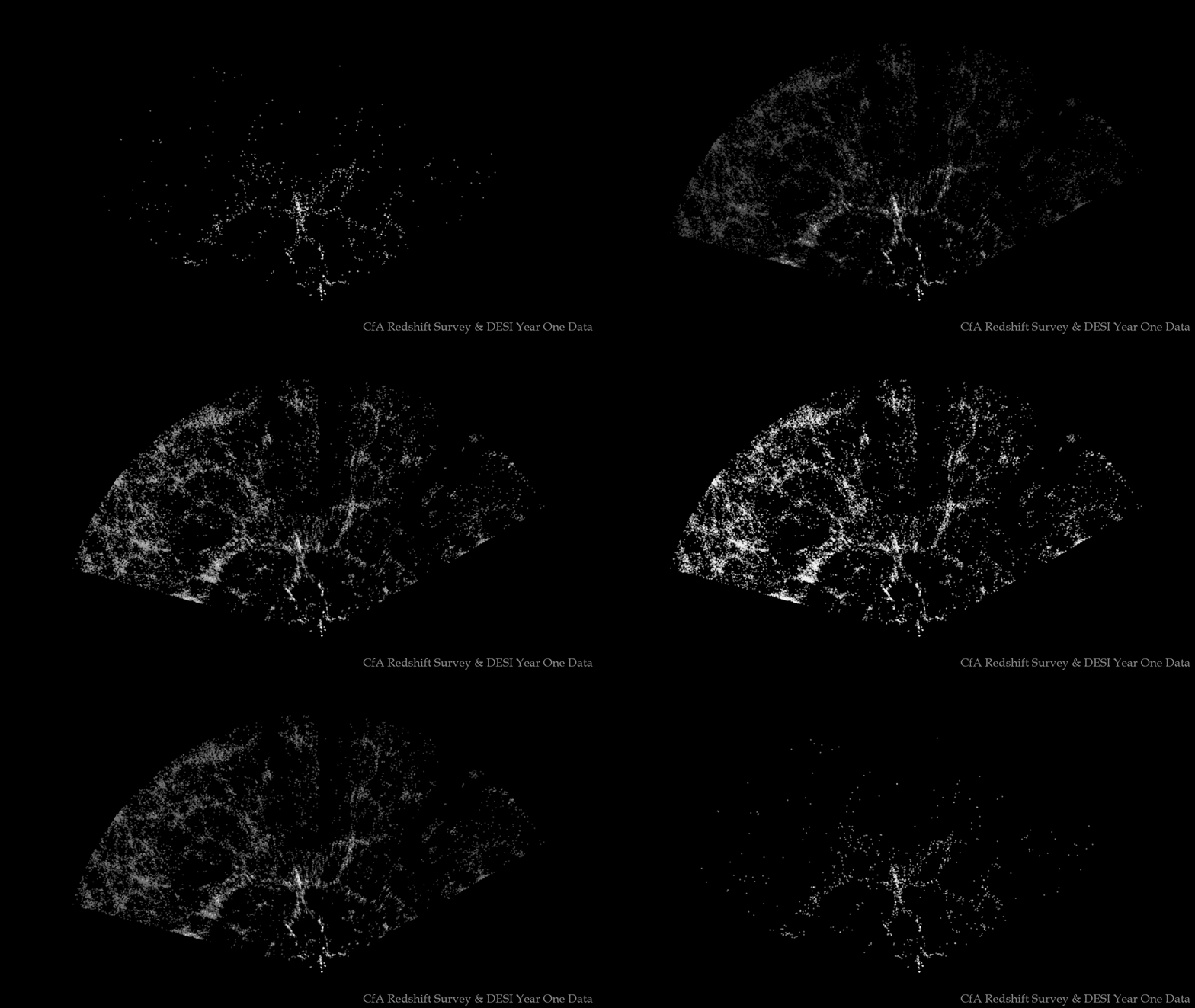
Forty years ago, the first and second CfA redshift surveys acquired spectra of 2200 and 15,000 galaxies respectively, giving us the first glimpses of the large scale structure of galaxies. Rather than being distributed randomly, galaxies were found to cluster in a froth-like structure, arranged on bubble-like surfaces surrounding large volumes mostly devoid of galaxies. In these pioneering surveys, redshifts were painstakingly acquired one at a time. As a result, the first CfA redshift survey took 5 years to acquire its 2200 redshifts (1977-1982). In comparison, on 12 February DESI acquired 100 times that number in a single night.

How does DESI do it?

Rather than taking spectra of galaxies one at a time, DESI can acquire 5000 spectra at once through its 5000 robotically positioned fibers. Tiny robots center each fiber on an object (galaxy, quasar, or star). After an exposure is done, the fibers are quickly repositioned, within 1-2 minutes, and DESI is ready to acquire spectra of another 5000 objects. On 12 February, the seeing at the Mayall Telescope was very good (0.65 arcseconds) and DESI was able to go through the setup process more than 40 times. (The gory details: DESI observed 41 dark tiles, 4 bright tiles, and 2 backup tiles that night.)

A spectacular night in a notable month

While February’s weather was relatively poor, DESI still managed to acquire 1.8 million spectra over the month. The quick progress keeps DESI on track to complete its planned survey of 30 million galaxies and quasars and 10 million stars within 5 years. By measuring the large scale structure of galaxies at high precision, the DESI survey will lend new insights into the expansion history of the Universe and the nature of dark matter and dark energy.

Comparison of the famous “CfA Stick Man” to DESI galaxies in the same region: a 6-degree slice in declination, spanning about a third of the sky. The CfA Stick Man was one of the first clear examples of large-scale structure in the Universe. Credit: Claire Lamman | The CfA Redshift Survey: Data for the NGP +30 Zone. Huchra, Geller, de Lapparent, Corwin 1990

Filed Under: blog, feature on homepage

Joan Najita (NOIRLab)

16 February 2024

BaoBan, DESI’s ambassador for Education and Public Outreach, made a recent appearance at the 85th Annual Tohono O’odham Nation Rodeo and Parade, featuring prominently in the parade entry from Kitt Peak National Observatory (KPNO). A coyote from the wilds of Arizona, BaoBan has previously appeared in comic strips and other DESI-related public engagement activities. The DESI project is being carried out at KPNO, which is located atop I’oligam Du’ag, in the homeland of the Tohono O’odham Nation.

BaoBan greeted spectators at the 2024 Tohono O’odham Rodeo parade (Credit: M. Edwards).

At this year’s rodeo parade, held 3 February 2024, KPNO entered a float decorated with images of BaoBan, planets, stars, and telescopes. Sarah Logsdon, one of the NOIRLab volunteers who accompanied the float along the parade route, was thrilled to see spectators drawing their grandchildren’s attention to the pictures on the float and connecting them to the written words for these, which were posted on the float in both O’odham and English.

Baoban’s name, which was selected by the Tohono O’odham Nation Youth Council, combines several ideas. “Bao” is reminiscent of the sound the coyote makes and is also the acronym for “baryon acoustic oscillations”, a technique DESI is using to study the nature of dark energy and the expansion history of the universe. “Ban” is the word for coyote in the Tohono O’odham language. “BaoBan” is also the short form of  “Ba: ‘o ñia g Ban” meaning “Where is coyote looking?”, which symbolizes our exploration of the wonders of the universe with DESI. Read the full story of BaoBan’s origins at https://www.desi.lbl.gov/2023/05/11/the-new-desi-ambassador-baoban/.

This was the first year Kitt Peak has entered a float in the rodeo parade. BaoBan brought good luck and the KPNO team was happy to learn that their float received first place in the business category. Congratulations to the team and thank you BaoBan!

NOIRLab volunteers who accompanied the KPNO float along the parade route included Jessica Harris, Jacelle Ramon-Sauberan, Alice Jacques, Pipa Fernandez, Sarah Logsdon, Michelle Edwards, and Lori Allen (Credit: L. Allen).

Filed Under: blog, feature on homepage

  • « Go to Previous Page
  • Go to page 1
  • Go to page 2

Primary Sidebar

Copyright © 2018 Dark Energy Spectroscopic Instrument [DESI]

  • / science /
    • science overview
    • cosmology and dark energy
    • redshifts and distance
    • mapping the universe
    • the DESI science mission
    • the DESI survey
    • imaging surveys
  • / instrument /
    • instrument overview
    • telescope
      • tohono o’odham
    • corrector
    • focal plane system
    • fiber system
    • spectrograph
    • instrument control system
    • data systems
    • bringing DESI to life
      • commissioning Instrument
      • protoDESI
  • / collaboration /
    • DESI team
    • DESI builders
    • collaborating institutions
    • sponsors
    • code of conduct
    • vendors
    • collaboration policies
  • / press /
    • announcements
    • in the news
    • press releases
    • tweets by desisurvey
    • blog
    • acknowledgments
  • / galleries /
    • videos
    • image gallery
  • / for scientists /
    • data releases
    • instrument design
    • imaging data
    • target selection and survey validation
    • theory and simulations
    • other DESI science
    • key publications
    • all DESI papers
    • team login
    • request a DESI speaker
    • internal
  • / education & outreach /
    • meet a DESI member
    • blog
    • DESI High
    • planetarium show
    • interactive visualizations
    • DESI Merch

Footer

TEAM LOGIN

twitter   instagram   facebook

Copyright © 2018 Dark Energy Spectroscopic Instrument [DESI]

Copyright © 2026 · Parallax Pro DESI on Genesis Framework · WordPress · Log in