• Skip to main content
  • Skip to primary sidebar
  • Skip to footer

Dark Energy Spectroscopic Instrument (DESI)

  • / science /
    • science overview
    • cosmology and dark energy
    • redshifts and distance
    • mapping the universe
    • the DESI science mission
    • the DESI survey
    • imaging surveys
  • / instrument /
    • instrument overview
    • telescope
      • tohono o’odham
    • corrector
    • focal plane system
    • fiber system
    • spectrograph
    • instrument control system
    • data systems
    • bringing DESI to life
      • commissioning Instrument
      • protoDESI
  • / collaboration /
    • DESI team
    • DESI builders
    • collaborating institutions
    • sponsors
    • code of conduct
    • vendors
    • collaboration policies
  • / press /
    • announcements
    • in the news
    • press releases
    • tweets by desisurvey
    • blog
    • acknowledgments
  • / galleries /
    • videos
    • image gallery
  • / for scientists /
    • data releases
    • instrument design
    • imaging data
    • target selection and survey validation
    • theory and simulations
    • other DESI science
    • key publications
    • all DESI papers
    • team login
    • request a DESI speaker
    • internal
  • / education & outreach /
    • meet a DESI member
    • blog
    • DESI High
    • planetarium show
    • interactive visualizations
    • DESI Merch

DESI Scientists Win Physics Video Contest

March 9, 2026 by

9 March 2026

Joan Najita (NOIRLab) and Andrea Muñoz-Gutiérrez (UNAM)

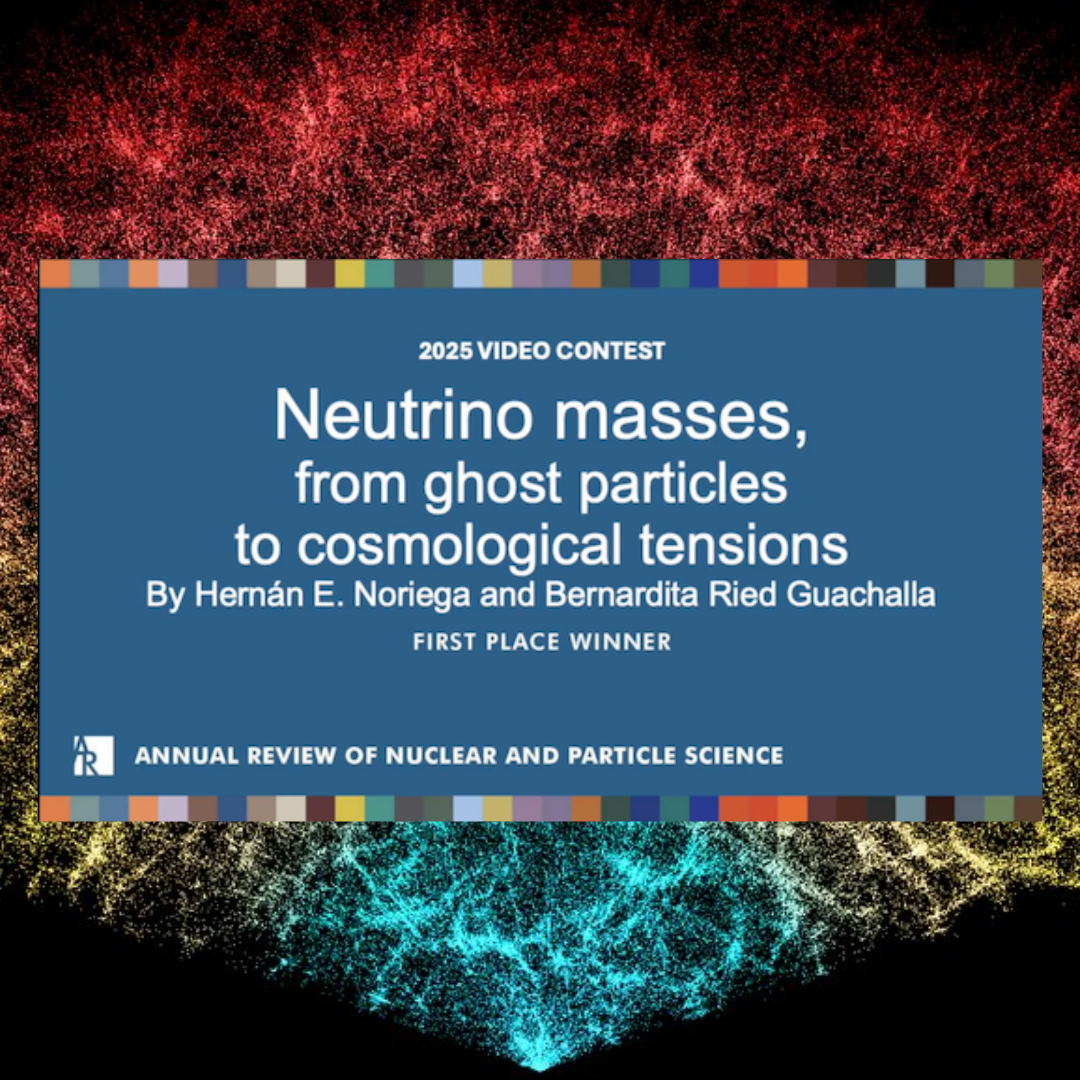
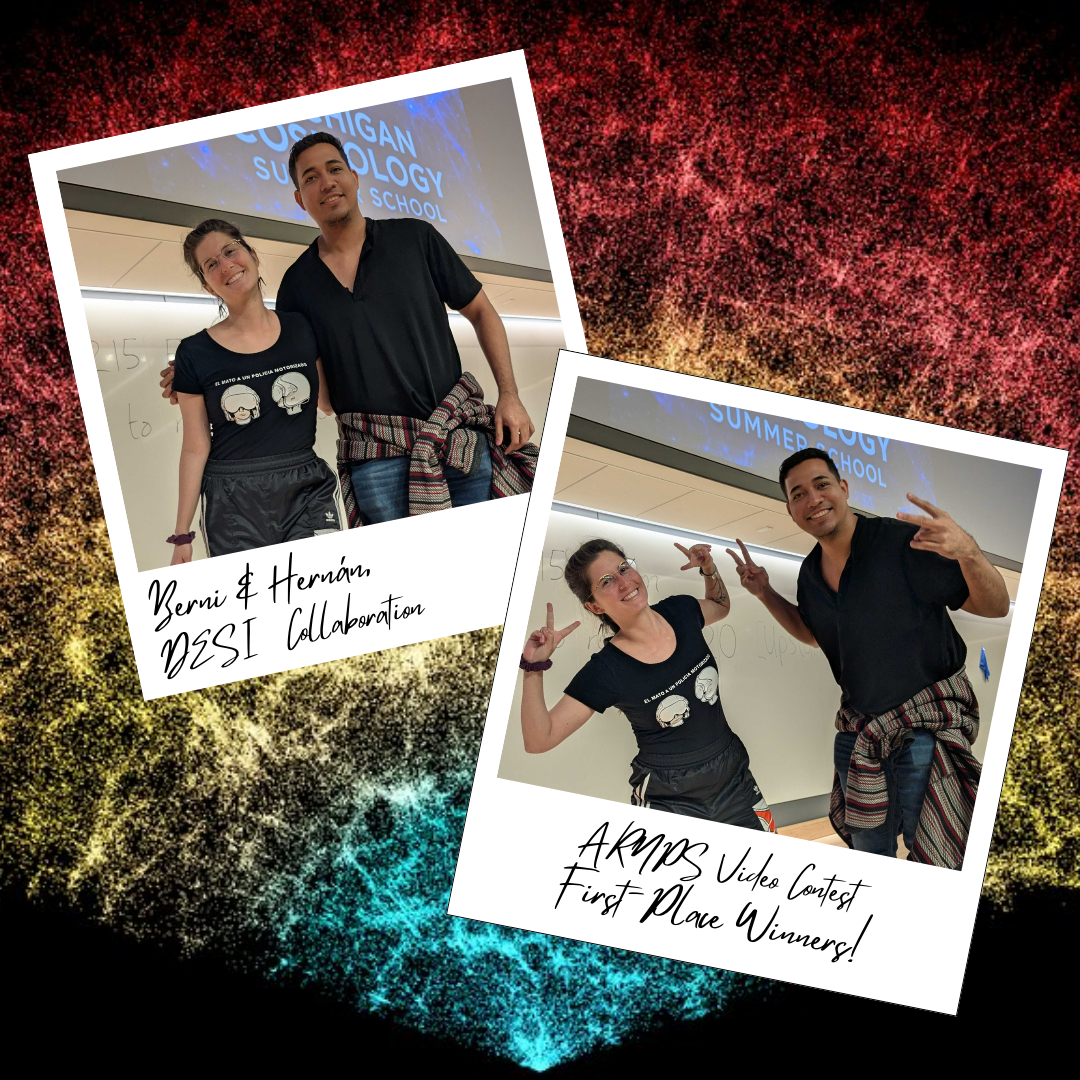
Two DESI scientists were recently awarded first place in the 2025 Annual Review of Nuclear and Particle Science Video Contest for their contribution, “Neutrino masses, from ghost particles to cosmological tensions,” which explains DESI’s results on the neutrino mass. We sat down with the winners, Hernán Noriega and Bernardita Ried Guachalla, to learn more about their research interests and their contest experience.

Q: Can you tell us a little about your research interests?

Hernán: My research focuses on the large-scale structure of the Universe. I work on perturbation theory and effective field theory methods to model galaxy clustering, with a particular emphasis on how massive neutrinos shape cosmic structure formation. More recently, I’ve also been exploring modified gravity scenarios.

Berni: My research interests scrutinize fundamental questions about our Universe:  What is the physical origin and evolution of the cosmos? What astrophysical knowledge can be inferred from astronomical surveys? What are dark matter and dark energy? And more specifically, what can we learn from the cosmic microwave background data when combining it with observations of the large-scale structure?

Q: Can you tell us about the video contest you entered?

Hernán: The contest was organized by Annual Reviews as part of the Annual Review of Nuclear and Particle Science (ARNPS). The goal was to encourage early-career researchers to translate cutting-edge nuclear or particle physics into a short, engaging, and accessible video for a broad audience. Participants submitted brief videos explaining a concept they have expertise in, and the winning entries were selected to be featured by Annual Reviews to reach researchers, educators, and science enthusiasts. More details about the contest are available on the ARNPS Video Contest page.

Q: What ideas and messages were you hoping share with the public? The idea of a negative neutrino mass seems crazy!

Berni: The video explores one of the most intriguing questions in modern physics: the total neutrino mass. Once thought massless, neutrinos are now known to have mass, but recent results from cosmology suggest limits so tight they even hint at “negative” values. We explain what neutrinos are, how oscillation and direct experiments like KATRIN measure their mass, and why cosmology offers a powerful but indirect probe. Current results from DESI, Planck, ACT, and SPT push constraints to unprecedented levels, exposing tensions between particle physics and cosmology. Could this mean that neutrinos hold the key to new physics, or even a revision of the ΛCDM model?

Q: What was DESI’s role in these results?

Hernán: DESI provides extremely precise measurements of large-scale structure through galaxy redshift surveys. These data tighten cosmological constraints by improving our handle on the expansion history and the growth of structure, which in turn helps constrain parameters like the sum of neutrino masses when combined with CMB datasets. Importantly, DESI can also place competitive neutrino-mass constraints on its own, with minimal external inputs, providing an independent cross-check that can be directly compared against other probes.

Q: …And you won first place! What was your reaction?

Hernán: I was truly thrilled…. especially because we are proud of the final result. We had a strong feeling it could do well, and after the final edit we thought the video was genuinely compelling. Winning first place was incredibly exciting.

Berni: Since I saw the contest I thought that we could win it. Hernán is a great colleague who knows a lot about neutrinos and he was visiting Stanford when we decided to do it. It was an amazing experience which allowed us to further explore ways of communicating DESI results in a different format.

To learn more, see Bernadita and Hernán’s 5-minute prize winning video, available here.
Filed Under: blog, feature on homepage

Primary Sidebar

  • DESI Explores the Extragalactic Time Domain Universe
  • DESI Reaches Mapping Milestone, Surpassing Expectations
  • DESI Scientists Win Physics Video Contest
  • DESI DR2 cosmology chains and data products released
  • DESI Collaboration Wins 2026 Berkeley Prize
  • Black Holes that Convert Matter into Dark Energy Allow for Positive Neutrino Masses
  • DESI High, the School of the Dark Universe, is Back!
  • DESI’s Evolving Dark Energy Lights up the News
  • At the Big Reveal: DESI’s December 2024 Unblinding Results
  • DESI DR2 Results: March 19 Guide
  • Closing Our Eyes to Truly See — “Blinding” in DESI’s Analysis of Its Cosmological Measurements
  • Charting the Dark Cosmic Web: Where DESI and Imaging Surveys Intersect
  • BaoBan Greets Spectators at 2025 Tohono O’odham Rodeo Parade
  • DESI Finds Black Holes are Common in Small Galaxies Too
  • Brushing Away the Dust to Uncover Cosmology: Examining the Sigma-8 Tension with DESI Galaxies
  • DESI’s 50M Milestone and a “Biggest Breakthrough” Honor
  • DESI 2024 Results: November 19 Guide
  • All is Not Lost: Tiny Groups of Galaxies Remember Their Origins
  • “5000 Eyes” Premieres in Mexico City
  • DESI 2024 Supporting Papers: June 11 Guide
  • DESI Joins in Hosting Kitt Peak Open Night for Tohono O’odham Nation; BaoBan Makes Guest Appearances
  • DESI 2024 in the News: Science Communicators Discuss the Cosmology Results from DESI’s Inaugural Year
  • DESI 2024 in the News: Is Dark Energy Weakening? New Uncertainty Invites Optimism About the Fate of the Universe
  • DESI 2024 Supporting Papers: April 11 Guide
  • DESI 2024 Results: April 4 Guide
  • A Record-Breaking Night
  • BaoBan Spotted at the Tohono O’odham Rodeo
  • A very nearby Type II Supernova in the Galaxy Messier 101
  • The DESI Early Data Release is now available
  • The new DESI ambassador: BaoBan
  • 5000 Eyes: creating the DESI planetarium film
  • Dusty views of the southwestern sky
  • Sneaking around with DESI data
  • Lightning and a lunar eclipse over Kitt Peak
  • Untangling the cosmic web
  • Recovery effort update two months after the Contreras Fire
  • First batch of Year 1 Key Project 1 papers
  • Contreras Fire threatens DESI and Kitt Peak National Observatory
  • One year and 12.8 million galaxy redshifts
  • DESI on a T-shirt (and stickers of course!)
  • Selecting targets for the DESI survey
  • The old is new again: social distancing while mapping the universe
  • Congratulations to Frank Valdes
  • The DESI peculiar velocity survey
  • DESI breaking records
  • A DIY guide for upgrading your $100 million world-class astronomical instrument
  • An upgraded DESI returns to the sky
  • Cosmic cartography
  • Diversity of DESI SV quasars
  • The beginnings of the 3-dimensional map
  • What do DESI’s 5000 eyes see?
  • Plugging away
  • DESI begins search for elusive dark energy
  • DESI begins its “One-Percent Survey”
  • DESI embarks on Survey Validation
  • An undergrad perspective on DESI
  • Women in DESI on International Women’s Day
  • Hunting the oxygen doublet in distant galaxies
  • Congratulations to David Weinberg
  • DESI imaging leaves a legacy at infrared wavelengths
  • DESI target selection
  • DESI successfully completes commissioning phase

Footer

TEAM LOGIN

twitter   instagram   facebook

Copyright © 2018 Dark Energy Spectroscopic Instrument [DESI]

Copyright © 2026 · Parallax Pro DESI on Genesis Framework · WordPress · Log in